
50 Years of the KCPR Pledge Drive

KCPR, Cal Poly’s student-run station, has been a campus mainstay for decades. As Cal Poly, the broader culture and music itself have evolved, the station has continued to make space for student experimentation, expression, storytelling and independent music.
This year marks the 50th anniversary of KCPR’s annual pledge drive, when donors support the station’s mission of nurturing student growth through hands-on Learn by Doing experiences while amplifying diverse sounds, voices and perspectives. To mark the occasion, the station hopes to raise $50,000.
In honor of the 50th anniversary, several longtime KCPR supporters reflected on what the station means to them and why they continue to give.
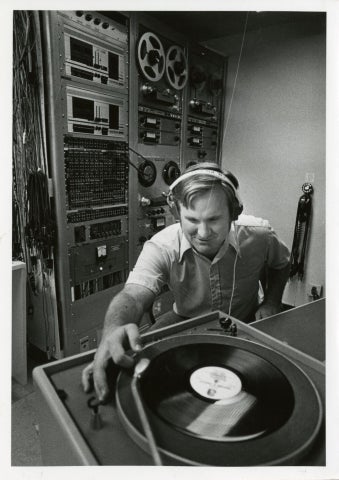
Rick DeBruhl (Journalism, ‘77)
DeBruhl was an early morning and late-night DJ and later general manager of KCPR. He covered auto racing for more than 30 years for networks including ESPN, Speed, Fox, CBS and NBC, and currently works for A&E TV networks. His first live racing remote broadcast was as a student broadcasting for KCPR at Laguna Seca, a racetrack near Monterey, California.
Todd Gilbreath (Cal Poly parent)
Gilbreath’s son, William, was a KCPR DJ for more than two years and is now engaged to another KCPR alumna. Although his son graduated in 2018, Gilbreath continues to listen online from his home in Arizona and especially enjoys the station’s world music programming.
Amy Eades (English, ‘94)
Eades was KCPR’s underwriting director, program director and a DJ known as “Amy K” on air who hosted “New Wave Mania,” featuring hits from the early ‘80s. She still listens online from her home in San Diego and follows the station on social media.
Tom Di Santo (Architecture, ‘89)
Di Santo is a former KCPR DJ and current host of “Speak Low” on KCBX, a show featuring jazz, French pop, trip- hop and downtempo indie, alternative and avant-garde music. He is now a professor in Cal Poly’s Architecture Department and a current Cal Poly parent. He still listens to KCPR live on the radio at 91.3 FM (on the left of the dial).
Why is KCPR important to you?
DeBruhl: “I spent a lot of time at KCPR during my time at Cal Poly, and it was probably the single most important thing I did there. It really prepared me to go out into the world and become a professional broadcaster.”
Gilbreath: “Music's always been a big part of our house, so I was really happy when my son got to Cal Poly and found the station. It was great for him. He met incredible people and made lifelong friends.”
Eades: “I loved everything about doing radio and KCPR. It was such a great community of people. When they say, ‘you find your people,’ they were my people. Not everyone liked the same music, but we all loved music, and that was what brought us together.”
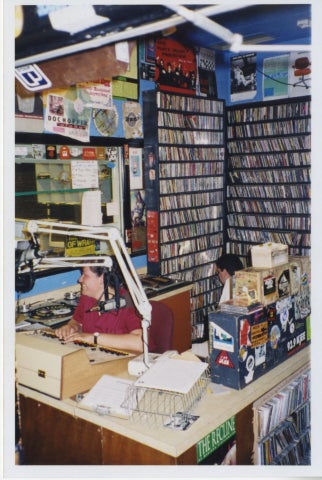
Di Santo: “KCPR is one of my top five radio stations on the planet. It’s important to me because I’m not only a devoted listener, but also a former DJ. I performed a show for six years called ‘Speak Low’ and have nothing but fond memories working for Burnt Dog Radio.”
What’s a favorite memory about KCPR?
DeBruhl: “The best part was the community. It wasn't just a place to play records. It was where you went to hang out with friends. Some of my best friends today are people I met when I was at KCPR.”
Gilbreath: “The first time my son was on air, they put him on at 2:30 in the morning. I remember getting up and listening to him. It was exciting to see him doing something he loved.”
Eades: “When Green Day was still unknown, before the ‘Dookie’ album came out, they played at a place called Loco Ranchero up on the hill on the south side of San Luis Obispo. It was an Earth Day show, and one of their openers was Beck.”
Di Santo: “Back when I was a DJ at KCPR, we had 24/7 live programming. I teach in the Architecture Department at Cal Poly. When I had my graveyard shift in the middle of the night, all of my students were working away in the lab, so I would take requests and play music for them since we all had to be up for different reasons.”
Why is KCPR important to Cal Poly?
DeBruhl: “KCPR is the epitome of Learn by Doing. The idea that you can go someplace on campus and get a taste of what it means to work in the major that you're going to be graduating from is fantastic. It was run by students 24 hours a day, seven days a week. We learned so much every single day that absolutely prepared every student there, me in particular, for the broadcasting world.”
Gilbreath: “Cal Poly has all different kinds of students. KCPR was a space for the music and arts people to go to be with their people and just be supported and make friends. At a lot of colleges, there's not a space like that.”
Eades: “I love that Cal Poly has been able to maintain a college station, because it provides a place for you to learn so much, not just how to talk on the radio. It builds your character and teaches you things about the world. I learned my limits of what I'm capable of, and certain things that I'm better at. And sometimes you learn the hard way. It's not just about playing records on the air.”
Di Santo: “KCPR is classic Learn by Doing. The station is exactly what Cal Poly is all about. I am a DJ at KCBX in San Luis Obispo, and I spin records live at some of the great venues we have here in town. Everything I needed to know I learned while being a DJ at KCPR.”
Why have you continued to support KCPR over the years?
DeBruhl: “KCPR was the single most important thing that I did at Cal Poly. It gave me a great tool, a great foundation for having a career. Being able to help and give back, even to a small degree, has been important to me. It helps me feel connected both to Cal Poly as well as knowing that I'm helping students who will hopefully go into journalism and broadcasting.”
Gilbreath: “If people hadn't supported KCPR before me, it might not have been there for my kid. I love what they do. I love the community. I want to make sure other people will have that same opportunity that my son had.”
Eades: “I believe in the importance of college radio, and I want it to be able to continue. This is a lab for broadcasting, and it makes Cal Poly unique, because not a lot of college stations are around anymore. Alumni support is critical to keeping it what it can be for students. It holds a special place in my heart, and that's why I support it.”
Di Santo: “I still support Burnt Dog Radio because I love the music. I donate during pledge drives to keep the great music coming. I keep developing graphics for the station because I want to inspire others to also donate.”


