
New Crowdfund Supports Interdisciplinary California History Research Project

For the past several years, a group of Cal Poly students from a range of majors has collaborated to unearth a little-known chapter of California’s past. Their research focuses on the state’s African-descended population and the roles they played in early California history, from the arrival of the Spanish in 1769 through statehood in 1850.
Now a new Cal Poly crowdfunding campaign has launched to help continue and expand this interdisciplinary research and raise awareness of this overlooked history. Funds raised will go directly to student salaries and travel to conferences and archives. Additional support would allow more students to join the project and help expand and accelerate the research.
Led by history lecturer Cameron Jones and computer science and software engineering professor Foaad Khosmood, the project involves creating and curating a public database of historical records, biographies, photographs and family trees of early Californios of African descent. The database is hosted at africancalifornios.org.
In addition to getting hands-on research experience, students collaborate and learn from peers with different academic backgrounds. Jones said working across disciplines helps students gain real-world experience and collaboration skills applicable in the workplace.
“I hope students learn how to work with messy data,” Jones said. “There are many different narratives that one can take from this, and I want them to be able to work with real data and real people — the type of challenges they’ll encounter in companies and government agencies. This fits Cal Poly’s Learn by Doing philosophy. This isn't theoretical. These are real data problems that we're dealing with.”
Khosmood said the project benefits his students by strengthening their communication skills.
“Inherently, computer scientists are building tools for other people," Khosmood said. “One of the most difficult skills we teach our students is how to communicate effectively with people who are not technical, how to understand their problems and then formulate that in terms of a technical solution. Programs like this that collaborate with the College of Liberal Arts are instrumental in developing that crucial skill.”
Jack Martin (History, ‘23, M.A. History, ‘25) and Savannah Bosley (Computer Science, ‘25) are recent graduates who worked on the project together. Both said working closely with their peers was an eye-opening and rewarding experience for them, just as much as the research.
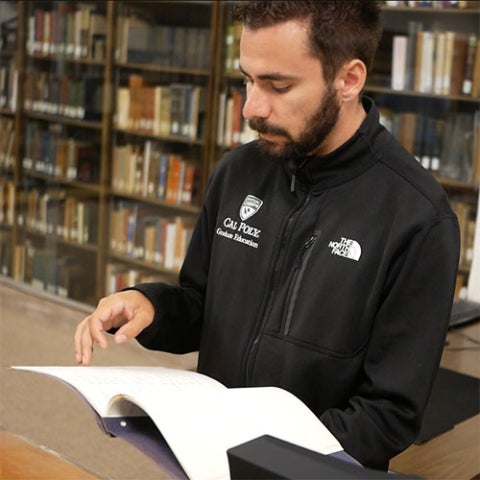
“It's led me to better understand how coding works and how all these different components come together to make information accessible and how we can make our vision possible,” Martin said. “It's been great to collaborate with computer engineering, computer science, and statistics students throughout the process.”
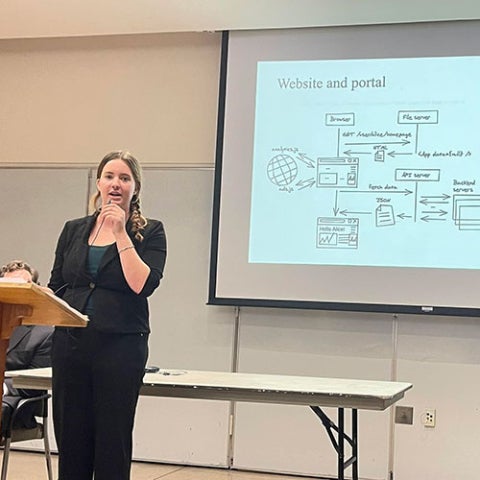
"As someone who came in with no prior knowledge of this part of history, it was really interesting to learn about,” Bosley said. “This project is a great opportunity to teach people about it.”
While many people know that California’s early non-Indigenous population was largely Mexican, most may not know that many individuals were of mixed African, Indigenous and European heritage. This challenges the common assumptions about when and how people of African descent arrived in the state. The website showcases the stories of individuals who rose to prominence during this era, including landowners, colonial governors and state senators. Some of the original Spanish soldiers stationed at the early colonial settlement in what is now San Luis Obispo were members of this group.
Martin began working on the project during his first quarter as a graduate student in 2023, and it allowed him to dive deeply into the state’s historical records. This involved analyzing baptismal, marriage, and death records from early California censuses.
“Part of that involved translating 18th- and 19th-century Spanish records that typically would have their parents’ names and their parents’ caste affiliation, which would essentially mean their race,” Martin said. “My main role has also been to construct family trees using primary source documents and secondary source data.”
While history students like Martin do the research, computer science students like Bosley work with the data to make the information accessible online.
"They had a website that worked well, but it had limitations in how it displayed data,” Bosley said. “They wanted to add an interactive component, so I joined the team."
Ultimately, the student researchers hope the project will help bring this forgotten story to life and make it accessible to a broad audience.
“That's why I love history,” Martin said. “There's always a deeper story and an opportunity to learn something that is often brushed over and needs more context.”


